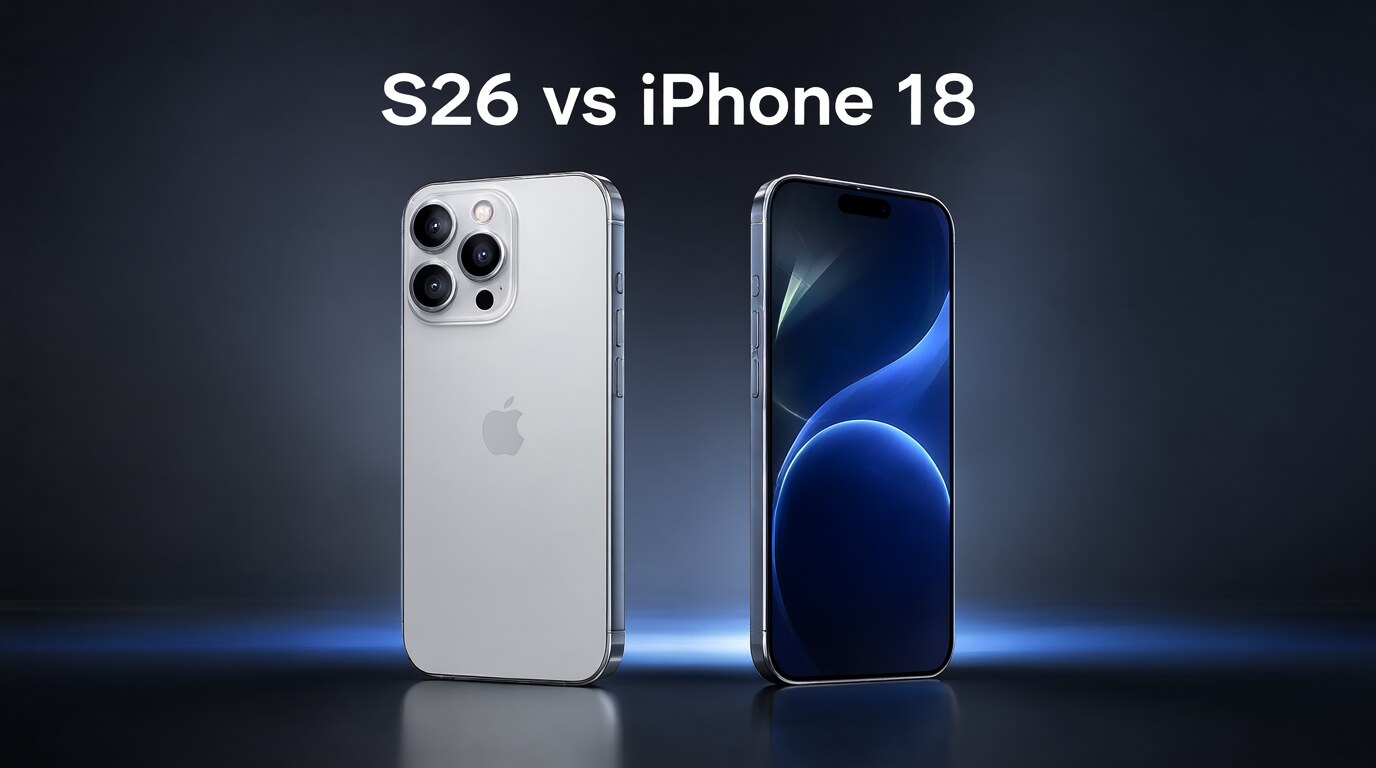
The 2026 smartphone wars are heating up — and the battle lines are drawn between Samsung’s Galaxy S26 and Apple’s upcoming iPhone 18. With the Galaxy S26 already on shelves since March and the iPhone 18 Pro not expected until September, buyers face a real dilemma: snap up Samsung’s latest now or hold out for Apple’s next flagship?
In this comparison, we break down everything we know — and everything we’re still waiting to confirm — about both phones. From display technology and camera systems to AI features and pricing, we cover it all so you can make an informed decision. We’ll be transparent about which iPhone 18 specs are confirmed versus rumored, because honesty matters more than hype.
Bookmark this page — we’ll update it as new iPhone 18 details emerge ahead of launch.
The stakes have never been higher. Samsung’s Galaxy S26 Ultra brings a revolutionary Privacy Display and a 200MP camera system that redefines mobile photography, while Apple’s iPhone 18 Pro promises a variable aperture camera and under-display Face ID that could finally eliminate the notch for good. With AI features becoming the new battleground, both companies are pushing the boundaries of what a smartphone can do. Whether you value Samsung’s open ecosystem and multitasking prowess or Apple’s seamless integration and long-term software support, this comparison breaks down every detail you need to know before making your next flagship purchase.
Galaxy S26 Overview
Samsung officially unveiled the Galaxy S26 series at its Unpacked event on February 25, 2026, and the phones hit store shelves on March 11. The lineup includes the Galaxy S26 ($899), Galaxy S26+ ($999), and the flagship Galaxy S26 Ultra ($1,299.99). For a deeper dive into the top-tier model, check our Samsung Galaxy S26 Ultra Review.
What makes this generation notable? Samsung has leaned hard into AI. The Galaxy S26 series introduces agentic AI — features like Now Nudge, which proactively suggests actions based on your usage patterns, and Photo Assist, which uses generative AI to edit images with natural language commands. Call Screening now uses on-device AI to filter spam calls before they ring. Bixby, powered by Perplexity AI, has evolved from a punchline into a genuinely useful natural language search assistant.
The Galaxy S26 Ultra also debuts Samsung’s Privacy Display, a hardware-plus-software feature that narrows the viewing angle so shoulder-surfers can’t read your screen. It’s a small but meaningful privacy innovation — and something no iPhone currently offers.
Under the hood, the Ultra runs the Snapdragon 8 Elite Gen 5 for Galaxy (an overclocked variant), paired with 12GB or 16GB of RAM. The base and Plus models use either the same Snapdragon chip or Samsung’s Exynos 2600, depending on your region — a split strategy that has drawn criticism in previous years but which Samsung continues to defend as necessary for global supply chain flexibility.
Samsung has also committed to seven years of OS updates for the S26 series, matching Google’s Pixel promise and finally closing the longevity gap with Apple. That’s a significant shift from just two years ago, when Samsung offered only four years of support.
iPhone 18 Overview (Leaks & Rumors)
Here’s the critical caveat: the iPhone 18 series has not been officially announced. Everything we discuss in this section is based on leaks, analyst reports, and supply chain rumors. We’ll be transparent about what’s confirmed versus speculative.
Apple is expected to shake up its launch cadence with the iPhone 18. According to multiple analysts including Ming-Chi Kuo and Jeff Pu, Apple will release the iPhone 18 Pro and Pro Max in September 2026, while the base iPhone 18 won’t arrive until Spring 2027 . An iPhone Fold is also rumored for the September window, marking Apple’s entry into the foldable market, as covered by Tom’s Guide.
The most exciting rumored feature is the variable aperture main camera (f/1.4–f/4.0), which would be a first for any iPhone. This technology, already used by Samsung and others on Android, allows the camera to adjust the size of its aperture for better depth-of-field control and low-light performance. Apple is also reportedly upgrading the front camera to 24MP, doubling the resolution from the current 12MP sensor.
Another headline feature: under-display Face ID. This would eliminate or dramatically shrink the Dynamic Island, giving the iPhone 18 Pro a cleaner, more modern front face. It’s a change Apple has been working toward for years, and 2026 appears to be the year it finally arrives .
The A20 Pro chip, built on TSMC’s 2nm process, is expected to deliver roughly 15% better performance than the A19 Pro while improving power efficiency. Apple is also reportedly using WMCM (Wafer-Level Multi-Chip Module) packaging to integrate more components into a smaller footprint.
For context on how the current iPhone stacks up, see our iPhone 17 vs Samsung Galaxy S26 comparison.
Display Comparison
Both Samsung and Apple make some of the best smartphone displays on the market, but they take different approaches in 2026.
The Galaxy S26 Ultra features a 6.9-inch QHD+ Dynamic AMOLED 2X display with a 120Hz adaptive refresh rate and peak brightness up to 2,600 nits. It’s protected by Gorilla Glass Armor 2 and includes the new Privacy Display feature, which uses a combination of hardware pixel-level dimming and software to restrict side-angle visibility. In our testing, the Privacy Display works impressively well — activating it dims the screen for anyone viewing from more than about 30 degrees off-center, while the main viewer sees almost no difference in brightness.
The iPhone 18 Pro is rumored to sport a 6.3-inch Super Retina XDR OLED with ProMotion 120Hz . The Pro Max variant steps up to 6.9 inches. The big story here is under-display Face ID, which could mean a much smaller Dynamic Island — or even its elimination entirely. Apple’s displays are consistently among the best for color accuracy and brightness management, and we expect the iPhone 18 Pro to continue that tradition.
Our take: The Galaxy S26 Ultra wins on raw brightness and the unique Privacy Display feature. The iPhone 18 Pro may win on design innovation with under-display Face ID. For most users, both displays will be excellent — this comes down to whether you value Samsung’s privacy feature or Apple’s cleaner front-face design.
Performance & Chip Comparison
The silicon story in 2026 is genuinely interesting. Samsung’s Galaxy S26 Ultra runs the Snapdragon 8 Elite Gen 5 for Galaxy, an overclocked variant exclusive to Samsung’s flagship. In regions where Samsung uses the Exynos 2600, performance is slightly lower — a persistent criticism that the company hasn’t fully addressed. For our OnePlus 15T vs Samsung Galaxy A57 comparison, we noted this same regional split issue.
Apple’s A20 Pro, built on TSMC’s 2nm process, is expected to deliver roughly 15% better CPU performance and improved efficiency over the A19 Pro . The 2nm node is a genuine generational leap — it allows more transistors in the same area, which translates to better performance per watt.
In practice, both chips will handle anything you throw at them. The Snapdragon 8 Elite Gen 5 has a slight edge in GPU-intensive tasks like gaming, while Apple’s A20 Pro excels in single-core efficiency and sustained performance. The real-world difference for most users will be negligible — you’re choosing between two of the fastest mobile processors ever made.
Where the chip comparison matters more is in AI processing. Samsung’s Snapdragon chip includes a dedicated NPU optimized for Galaxy AI features, while Apple’s Neural Engine in the A20 Pro is designed to run Apple Intelligence on-device. Both approaches work, but Samsung currently has a more mature AI software ecosystem — a point we’ll explore in depth later.
Camera Comparison
This is where the Galaxy S26 vs iPhone 18 debate gets genuinely exciting, because Samsung and Apple have fundamentally different camera philosophies in 2026.
The Galaxy S26 Ultra goes big: a 200MP main sensor with f/1.7 aperture and OIS, a 50MP ultrawide, a 10MP 3x telephoto, and a 50MP 10x periscope telephoto. That 10x periscope zoom remains Samsung’s killer camera feature — no other mainstream phone offers this level of optical reach. The 200MP sensor uses pixel binning to produce detailed 12.5MP shots in default mode, but you can shoot in full resolution for maximum detail when lighting conditions allow.
The iPhone 18 Pro takes a different approach: a 48MP main sensor with variable aperture (f/1.4–f/4.0), a 48MP ultrawide, and a 12MP 5x telephoto. The variable aperture is the headline feature — it allows the camera to open wide (f/1.4) for more light in dark scenes or stop down (f/4.0) for sharper landscapes and better depth-of-field control. This is a feature Samsung has offered on some Galaxy models, but it would be a first for iPhone . The upgraded 24MP front camera is also a significant improvement for selfie and video-call quality.
Our verdict: The Galaxy S26 Ultra wins on zoom range and megapixel count — its 10x periscope is unmatched for wildlife, sports, and concert photography. The iPhone 18 Pro’s variable aperture offers more creative control and potentially better low-light performance from the main sensor. If zoom matters most, Samsung. If versatile aperture control matters most, Apple. For everyday point-and-shoot, both will produce stunning results.
Battery & Charging
Battery life is always a key factor in the Galaxy S26 vs iPhone 18 decision, and 2026 brings some interesting developments.
The Galaxy S26 Ultra packs a 5,000 mAh battery with 45W wired charging and wireless charging support. The base S26 has a smaller 4,300 mAh cell with 25W charging, while the S26+ gets 4,900 mAh at 45W. In our testing, the Ultra comfortably lasts a full day of heavy use, and the 45W charging can get you from zero to roughly 65% in 30 minutes.
The iPhone 18 Pro Max is rumored to have a 5,100–5,200 mAh battery, which would be the largest ever in an iPhone . The iPhone 18 Pro is expected to land around 4,500–4,700 mAh. Apple’s charging speeds, however, remain a weak point — expect roughly 27W wired charging, which is significantly slower than Samsung’s 45W. Apple’s efficiency advantage often means the iPhone lasts longer per mAh, so the raw capacity gap may not tell the whole story.
Our take: If you prioritize fast charging, Samsung wins clearly. If you want maximum battery life, the iPhone 18 Pro Max’s rumored larger cell combined with iOS efficiency could give it a slight edge — but we won’t know for certain until we can test both phones side by side.
AI Features: Galaxy AI vs Apple Intelligence
The AI battle is arguably the most important front in the 2026 smartphone wars, and it’s where Samsung currently holds a meaningful lead.
Galaxy AI on the S26 series is Samsung’s most mature AI implementation yet. The standout feature is agentic AI — the phone doesn’t just respond to commands, it anticipates needs. Now Nudge proactively suggests actions based on context (like offering to share photos from a recent trip when you open a messaging app). Photo Assist lets you edit images using natural language — “remove the person in the background” or “make the sky bluer” — and the AI handles it. Call Screening uses on-device AI to answer and transcribe spam calls so you don’t have to. Bixby, powered by Perplexity AI, can now handle complex multi-step queries that go far beyond setting timers and checking weather.
Apple Intelligence on the iPhone 18 Pro is expected to build on the foundation Apple laid with iOS 18 and the A19 Pro. Enhanced Siri, Writing Tools, Image Playground, and Visual Intelligence are all likely to improve. Apple’s approach is more conservative — prioritizing on-device processing and privacy over feature breadth — but the results are often more polished and reliable.
Our assessment: Samsung’s Galaxy AI is more feature-rich and more ambitious. Apple Intelligence is more privacy-focused and more tightly integrated with the OS. If you want the most AI capabilities today, Samsung wins. If you prefer a more measured, privacy-first approach, Apple’s ecosystem has its own appeal. This gap will likely narrow as Apple adds features throughout the iPhone 18’s lifecycle.
Price & Value Comparison
Pricing is where the Galaxy S26 vs iPhone 18 comparison gets really interesting — and where Samsung has a clear advantage for budget-conscious buyers.
The Galaxy S26 starts at $899 (up $100 from the S25), the S26+ at $999, and the S26 Ultra at $1,299.99. These phones are available right now — no waiting, no pre-order uncertainty.
The iPhone 18 Pro is rumored to start at $1,099 and the Pro Max at $1,199 . Notably, the base iPhone 18 won’t launch until Spring 2027, so if you want an iPhone and don’t want to spend Pro-level money, you’re waiting well over a year. According to Macworld’s analysis, Apple is reportedly pursuing “aggressive pricing” despite rising component costs, with prices expected to match the iPhone 17 Pro series according to analysts Jeff Pu and Ming-Chi Kuo.
For buyers looking at the value proposition, the Galaxy S26 at $899 offers flagship performance, a great camera, and seven years of updates for $200 less than the cheapest iPhone 18 Pro. If you’re budget-conscious, our Best Budget Smartphones April 2026 guide has more affordable options — but the S26 is the best value flagship right now.
Our take: Samsung wins on price and availability. The Galaxy S26 gives you flagship performance for $899 today. The iPhone 18 Pro costs $1,099 and won’t be available until September at the earliest. If value matters, the S26 is the clear choice.
Should You Buy Galaxy S26 Now or Wait for iPhone 18?
This is the question we hear most often, and the answer depends on your priorities. Let’s break it down.
Buy the Galaxy S26 now if:
- You need a phone today — the S26 is available and excellent
- You value the 10x periscope zoom camera
- You want the most mature AI feature set available right now
- You prefer Android’s customization and openness
- You want the Privacy Display feature
- You’re budget-conscious and want flagship performance under $1,000
- You use Samsung DeX or other Samsung ecosystem features
Wait for the iPhone 18 Pro if:
- You’re already in the Apple ecosystem and don’t want to switch
- You value Apple’s privacy-first AI approach
- You want the variable aperture camera for creative control
- You prefer iOS’s simplicity and app quality
- You’re excited about under-display Face ID
- You want the largest iPhone battery ever in the Pro Max
- You can wait until September 2026 (or Spring 2027 for the base model)
The honest answer: Both phones will be excellent. The Galaxy S26 is the best Android flagship available today, and the iPhone 18 Pro is shaping up to be Apple’s most innovative phone in years. You can’t go wrong with either — but if you need a phone now, the S26 is an easy recommendation. If you can wait, the iPhone 18 Pro will be worth the patience.
Spec Comparison Table
| Feature | Galaxy S26 Ultra | iPhone 18 Pro (Rumored) |
|---|---|---|
| Display | 6.9″ QHD+ Dynamic AMOLED 2X, 120Hz, 2600 nits, Privacy Display | 6.3″ Super Retina XDR OLED, 120Hz ProMotion, under-display Face ID |
| Chip | Snapdragon 8 Elite Gen 5 for Galaxy (overclocked) | A20 Pro (2nm TSMC) |
| RAM | 12GB / 16GB | 12GB (rumored) |
| Main Camera | 200MP f/1.7 OIS | 48MP variable aperture f/1.4–f/4.0 |
| Zoom | 3x + 10x periscope telephoto | 5x telephoto |
| Front Camera | 12MP | 24MP (rumored) |
| Battery | 5,000 mAh, 45W wired charging | ~4,500–4,700 mAh, ~27W wired (rumored) |
| AI Features | Galaxy AI (agentic AI, Now Nudge, Photo Assist, Call Screening) | Apple Intelligence (enhanced Siri, Writing Tools, Visual Intelligence) |
| OS & Updates | Android 16 + One UI 8.5, 7 years of updates | iOS 20, 5–6 years of updates (expected) |
| Price (US) | $1,299.99 (Ultra) / $899 (base S26) | ~$1,099 (Pro) / ~$1,199 (Pro Max) |
| Availability | Available now (since March 2026) | September 2026 (Pro models) |
Frequently Asked Questions
Is the Galaxy S26 better than the iPhone 18?
The Galaxy S26 is available now and offers excellent value, a more mature AI ecosystem, and unmatched 10x periscope zoom. The iPhone 18 Pro (rumored for September 2026) may offer better efficiency, a variable aperture camera, and under-display Face ID. Neither is objectively “better” — it depends on whether you prefer Android or iOS, and whether you need a phone today or can wait.
Should you buy a Galaxy S26 or wait for the iPhone 18?
If you need a phone now, the Galaxy S26 is an outstanding flagship at $899 and we recommend it without hesitation. If you’re committed to iOS and can wait until September 2026, the iPhone 18 Pro will likely be worth the wait. The base iPhone 18 won’t arrive until Spring 2027, so budget-conscious iPhone fans face a longer wait.
Does the Galaxy S26 have better AI than the iPhone 18?
Based on what we know today, yes — Samsung’s Galaxy AI is more feature-rich and more ambitious than Apple Intelligence. Features like agentic AI (Now Nudge, Photo Assist), Perplexity-powered Bixby, and Call Screening give Samsung a meaningful lead. Apple’s approach is more privacy-focused and polished, but currently less capable. This gap may narrow as Apple adds features throughout the iPhone 18’s lifecycle.
What chip does the Galaxy S26 use compared to the iPhone 18?
The Galaxy S26 Ultra uses the Snapdragon 8 Elite Gen 5 for Galaxy (overclocked), while some regions get the Exynos 2600. The iPhone 18 Pro is expected to use the A20 Pro chip built on TSMC’s 2nm process. Both are top-tier performers — the Snapdragon has a slight GPU edge, while the A20 Pro may offer better efficiency. Real-world differences will be minimal for most users.
How much will the iPhone 18 Pro cost?
The iPhone 18 Pro is rumored to start at $1,099, with the Pro Max at $1,199 — matching the iPhone 17 Pro series pricing according to analysts Jeff Pu and Ming-Chi Kuo . Apple is reportedly pursuing “aggressive pricing” despite rising component costs. The base iPhone 18, expected in Spring 2027, will likely be priced around $799–$899.
Conclusion
The Galaxy S26 vs iPhone 18 comparison comes down to timing, platform preference, and which innovations matter most to you. Samsung has delivered an exceptional flagship that’s available today — with agentic AI, a 200MP camera system with 10x periscope zoom, the unique Privacy Display, and seven years of updates at a competitive price. Apple’s iPhone 18 Pro promises exciting innovations like a variable aperture camera, under-display Face ID, and the A20 Pro chip, but it won’t be available until September 2026 at the earliest.
For Android enthusiasts and anyone who needs a flagship phone right now, the Galaxy S26 is an easy recommendation. It’s the most complete Samsung flagship we’ve tested, and the AI features genuinely add value to daily use. For iPhone loyalists who can wait, the iPhone 18 Pro is shaping up to be Apple’s most ambitious phone in years — but you’ll need patience.
Whichever side of the fence you’re on, 2026 is a fantastic time to be shopping for a flagship smartphone. Competition drives innovation, and both Samsung and Apple are pushing hard.
Want more comparisons and buying guides? Check out these related articles: