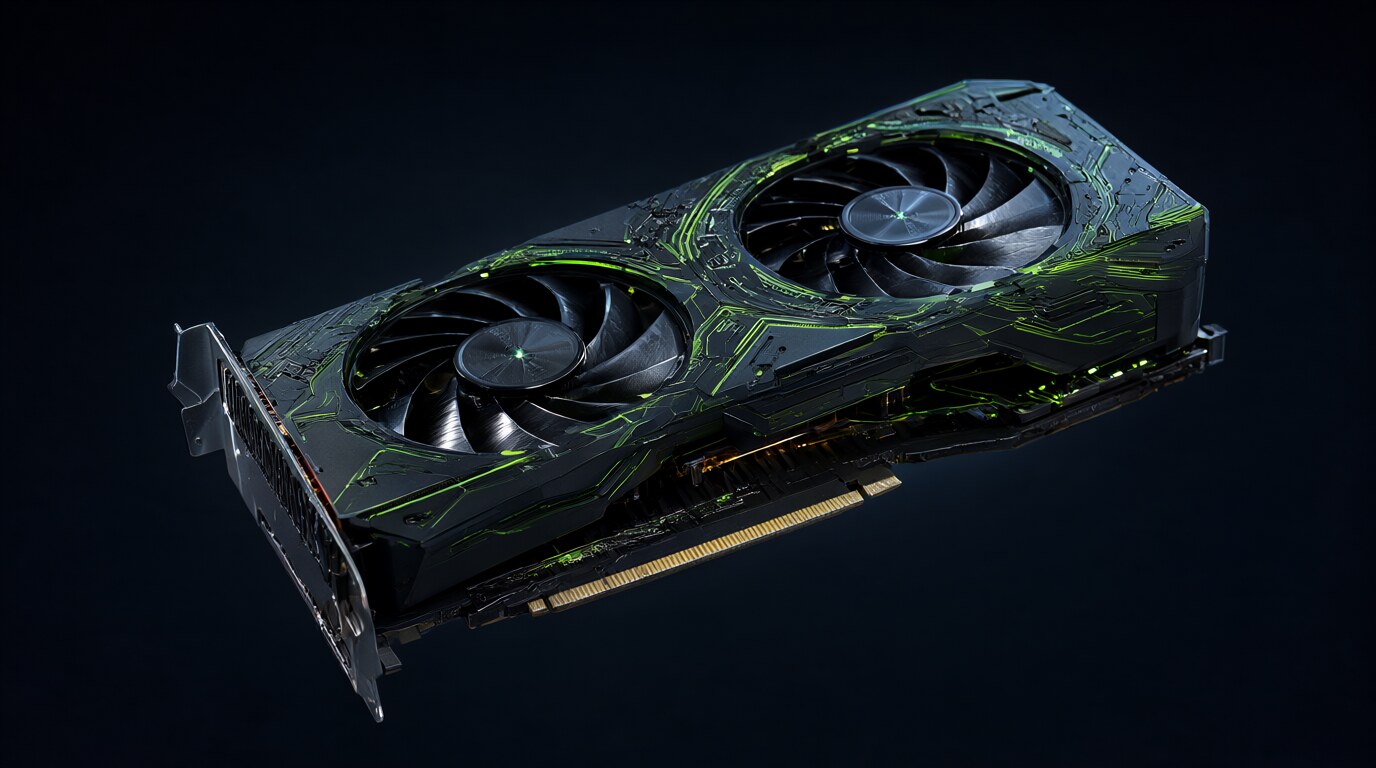
The NVIDIA RTX 6070 is shaping up to be one of the most consequential mid-range GPU launches in years — and possibly the most controversial. With leaks pointing to 16 GB of GDDR7 memory on a 256-bit bus, a Rubin architecture built on TSMC’s 3 nm process, and a claimed 2x improvement in ray tracing performance, the RTX 6070 promises a generational leap that could redefine what gamers expect from a $550–$650 graphics card. But not everyone is convinced.
In this guide, we break down every credible leak, analyze the specs that matter most for 1440p gaming, and examine whether the RTX 6070’s upgrades justify what will almost certainly be a higher price tag. We also compare it head-to-head with the RTX 5070 and AMD’s RX 9070 XT so you can make an informed decision when the time comes.
Bookmark this page — we update it as new information emerges ahead of the expected 2027 launch.
Updated October 2026: Still nothing official from NVIDIA. Reporting now splits between an H1 2027 launch and a slip to 2028 — March 2027 remains the earliest credible window. Details in the release-date section.
RTX 6070 Overview: What We Know So Far
The RTX 6070 is NVIDIA’s upcoming mid-range GPU based on the Rubin architecture — named after astronomer Vera Rubin and first unveiled on data-center hardware at CES 2026. While the flagship RTX 6090 will inevitably grab headlines, the RTX 6070 is the card most gamers will actually buy, and its specs carry outsized importance for the entire market.
According to multiple leak sources — including TechPowerUp’s GPU database, RedGamingTech, and cputronic — the RTX 6070 is expected to feature 6,144 CUDA cores, 16 GB of GDDR7 memory, and a 256-bit memory bus. Those are significant upgrades over the current RTX 5070, which ships with 12 GB of GDDR7 on a narrower 192-bit bus.
But here is where things get complicated. Not all leaks agree. PCGamer’s data-driven analysis predicts a 192-bit bus based on historical patterns, while TechPowerUp and TechSpot report 256-bit. VideoCardz and TechSpot have both warned that finalized specs for Rubin-based gaming GPUs simply do not exist yet, and the French outlet Clubic has called the current wave of leaks unfounded rumors.
We want to be transparent: every specification listed in this article is based on leaks and should be treated as unconfirmed until NVIDIA’s official announcement. We mark all unconfirmed specs with throughout.
For a broader look at the entire lineup, check out our NVIDIA RTX 60 Series: Everything We Know About the Rubin Architecture overview. This article focuses exclusively on what the RTX 6070 means for mid-range gamers.
Leaked Specs: RTX 6070 Specifications Breakdown
Here are the RTX 6070 specifications as reported by multiple leak sources. Remember: every figure below is unconfirmed and marked with .
| Specification | RTX 6070 (Leaked) | RTX 5070 (Current) | RX 9070 XT (Current) |
|---|---|---|---|
| Architecture | Rubin (3 nm) | Blackwell (5 nm) | RDNA 4 (4 nm) |
| GPU Die | GR205-300-A1 | GB205 | Navi 48 |
| CUDA Cores / Stream Processors | 6,144 | 6,144 | 4,096 (64 CUs) |
| VRAM | 16 GB GDDR7 | 12 GB GDDR7 | 16 GB GDDR6 |
| Memory Bus | 256-bit [VERIFY — disputed] | 192-bit | 256-bit |
| Memory Bandwidth | ~672 GB/s or higher | 672 GB/s | ~576 GB/s |
| L2 Cache | 48 MB | — | — |
| Base Clock | 2,400 MHz | 2,162 MHz | — |
| Boost Clock | 2,600 MHz | 2,510 MHz | 2,970 MHz |
| TDP | ~250W | 250W | 220W |
| RT Cores | 5th Gen | 4th Gen | 3rd Gen (RDNA 4) |
| DLSS Support | DLSS 5 (expected) | DLSS 4 | FSR 4 |
| MSRP | $549–$649 (estimated) | $549 | $549 |
A few things jump out immediately. The RTX 6070 reportedly shares the same 6,144 CUDA core count as the RTX 5070, which means performance gains must come from architectural improvements, higher clocks, and better memory bandwidth rather than raw core count increases. The jump from 12 GB to 16 GB of VRAM is the single most meaningful upgrade for gamers — and we have already explained why in our RTX 5060 Ti 8GB: Why 8GB of VRAM Is No Longer Enough in 2026 deep dive.
The Rubin Architecture: Why 3 nm Matters for Mid-Range
The RTX 6070’s move to the Rubin architecture on TSMC’s 3 nm process node is arguably its most important technical story. NVIDIA debuted Rubin on data-center GPUs at CES 2026, and the gaming variants — codenamed GR200-series dies — will bring this architecture down to consumer price points.
Why does 3 nm matter for a mid-range card? Two words: efficiency and density. The jump from Blackwell’s 5 nm to Rubin’s 3 nm allows NVIDIA to fit more transistors into the same die area while consuming less power. For the RTX 6070 specifically, this means NVIDIA can deliver 5th-generation RT cores and higher clock speeds within the same 250W power envelope as the RTX 5070 .
The 5th-gen RT cores are particularly significant. According to RedGamingTech’s leak, NVIDIA is targeting a 2x improvement in path tracing and ray tracing performance over the RTX 50 series . If that claim holds even partially true, the RTX 6070 could deliver ray tracing performance that rivals or exceeds the current RTX 5080 — a card that costs $999 — in RT-heavy workloads.
Rasterization improvements are more modest. Current estimates suggest roughly a 30% improvement in traditional raster performance over the RTX 5070 . That is a solid generational bump, but it may disappoint gamers who expect a larger leap given the architecture change.
DLSS 5 is the other major architectural feature. NVIDIA demonstrated DLSS 5 at CES 2026 using dual RTX 5090s, and the goal is to bring this technology to single-GPU configurations, including mid-range cards like the RTX 6070 . While details remain scarce, DLSS 5 is expected to push frame generation quality even further than DLSS 4’s Multi Frame Generation.
RTX 6070 vs RTX 5070: Is the Upgrade Worth It?
The RTX 5070 launched at $549 with 12 GB of GDDR7 on a 192-bit bus, and it has been a popular choice for 1440p gaming. The RTX 6070 needs to offer a compelling reason for current RTX 5070 owners — or prospective buyers — to choose it instead.
Where the RTX 6070 wins clearly:
- VRAM: 16 GB vs 12 GB — a 33% increase that matters enormously for 1440p ultra textures and future-proofing. Modern titles like Cyberpunk 2077 and Alan Wake 2 already push past 10 GB at 1440p with ray tracing enabled.
- Memory bus: 256-bit vs 192-bit — if confirmed, this delivers significantly more memory bandwidth, reducing stuttering in VRAM-heavy scenarios.
- Ray tracing: 5th-gen RT cores with a claimed 2x path tracing improvement could make RT the default rather than a luxury setting.
- DLSS 5: Support for NVIDIA’s latest upscaling and frame generation tech .
- Process node: 3 nm vs 5 nm means better efficiency and potentially lower temperatures at the same TDP.
Where the RTX 6070 raises concerns:
- Same CUDA core count: 6,144 cores — identical to the RTX 5070. Performance gains rely on architecture and clocks, not raw compute.
- Modest raster improvement: ~30% over the RTX 5070 is decent but not a generational leap by historical standards.
- Higher price likely: Rising GDDR7 memory costs and expensive TSMC 3 nm wafers almost guarantee a price increase. GameGPU reports the RTX 6000 series could be the most expensive in history.
- Same TDP: 250W — no improvement in power efficiency at the board level, even though the 3 nm node should theoretically help.
For gamers currently on an RTX 4070 or older, the RTX 6070 represents a meaningful upgrade across every metric that matters. For RTX 5070 owners, the calculus is harder — the 16 GB of VRAM and superior ray tracing may not justify the cost of upgrading within a single generation.
RTX 6070 vs RX 9070 XT: NVIDIA vs AMD in 2027
At launch, the RTX 6070’s closest AMD competitor will be the RX 9070 XT — but this comparison comes with an important caveat. The RX 9070 XT launched in early 2025 on the RDNA 4 architecture, meaning it will be roughly two years old when the RTX 6070 arrives. AMD’s RDNA 5 response is expected but not yet announced.
Still, the RX 9070 XT remains relevant because it offers 16 GB of VRAM at the same $549 MSRP that the RTX 5070 launched at. Here is how the two cards compare on paper:
RTX 6070 advantages over the RX 9070 XT:
- GDDR7 vs GDDR6: The RTX 6070’s GDDR7 memory delivers substantially higher bandwidth than the RX 9070 XT’s GDDR6, even though both offer 16 GB on a 256-bit bus.
- Ray tracing: NVIDIA’s 5th-gen RT cores should deliver significantly better RT and path tracing performance than AMD’s RDNA 4 RT implementation.
- DLSS 5 vs FSR 4: NVIDIA’s AI upscaling ecosystem remains more mature. That said, FSR 4 has made impressive strides — and yes, FSR 4 on Nvidia GPUs: Yes, It Works — Here’s How if you want the full breakdown.
- Process advantage: 3 nm vs 4 nm gives NVIDIA better efficiency per transistor.
RX 9070 XT advantages:
- Price: At $549, the RX 9070 XT will likely be significantly cheaper than the RTX 6070 at launch.
- Lower TDP: 220W vs 250W — modest but real.
- Availability: The RX 9070 XT is available now; the RTX 6070 is not expected until March 2027 at the earliest — and some October 2026 reporting now points to a possible 2028 slip.
- Open-source drivers: AMD’s Linux and open-source driver support remains superior.
The real question is whether AMD will launch an RDNA 5-based competitor alongside or shortly after the RTX 6070. Until then, the RX 9070 XT remains the budget-conscious alternative for gamers who prioritize raw performance per dollar over ray tracing and DLSS.
The 256-bit vs 192-bit Bus Controversy Explained
One of the most debated aspects of the RTX 6070 leaks is the memory bus width. TechPowerUp and TechSpot report a 256-bit bus , while PCGamer’s historical analysis predicts 192-bit. Why does this matter so much?
Memory bus width determines bandwidth. A 256-bit bus with GDDR7 at effective speeds would deliver substantially more bandwidth than a 192-bit bus — potentially the difference between smooth 1440p ultra gameplay and VRAM-related stuttering in demanding titles. With 16 GB of VRAM on a 256-bit bus, the RTX 6070 would have a clear memory subsystem advantage over the RTX 5070’s 12 GB on 192-bit.
But the 256-bit claim faces skepticism. NVIDIA has historically narrowed the memory bus on mid-range cards to protect higher-tier product margins. The RTX 5070 uses a 192-bit bus. The RTX 4070 used a 128-bit bus. A jump to 256-bit would break this pattern — and that is exactly why some analysts doubt it.
Our assessment: The 256-bit bus is plausible if NVIDIA wants to clearly differentiate the RTX 6070 from the RTX 5070 and compete with AMD’s 256-bit RX 9070 XT. However, we would not be surprised to see a 192-bit bus with faster GDDR7 memory that achieves similar bandwidth. Either way, the 16 GB VRAM capacity is the upgrade that matters most for gamers.
RTX 6070 Price Predictions and Value Proposition
No official pricing exists for the RTX 6070, but the signs point to a price increase over the RTX 5070’s $549 MSRP. Our estimate: $549–$649 , with the most likely landing point around $599.
Several factors are driving upward price pressure:
- GDDR7 memory costs: GDDR7 is newer and more expensive than GDDR6, and the RTX 6070 reportedly uses 16 GB of it. Tom’s Guide has noted that rising VRAM pricing is a significant cost factor.
- TSMC 3 nm wafers: The 3 nm process is expensive, and NVIDIA is choosing a conservative node over bleeding-edge sub-2 nm technology partly to manage costs.
- Market positioning: With the RTX 6090 likely launching above $2,000 and the RTX 6080 around $1,000+, NVIDIA has room to push the RTX 6070’s price upward without cannibalizing higher tiers.
At $599, the RTX 6070 would offer strong value if the 16 GB of GDDR7 and 2x ray tracing improvement hold true. At $649, the value proposition becomes harder to justify against a discounted RX 9070 XT — especially if AMD drops prices ahead of the RTX 6070 launch.
The bottom line: the RTX 6070 will likely cost more than the RTX 5070, and whether it is worth the premium depends entirely on how much you value VRAM, ray tracing, and DLSS 5.
RTX 6070 Release Date: When Can You Buy One?
Multiple sources — including GameGPU, cputronic, and SiliconCat — list the RTX 6070 launch as March 2027 . RedGamingTech reports a Q1 2027 timeframe, while Tom’s Guide and Tom’s Hardware suggest H2 2027 is possible due to GDDR7 pricing pressures and potential RTX 50 Super series delays.
Update (October 2026): Nothing is official yet. Reporting now splits: some outlets place the RTX 60 family window in the first half of 2027, while others increasingly discuss a slip to 2028 as AI demand continues to consume TSMC capacity. A September 2026 GameGPU report also suggests the RTX 6080 could launch before the RTX 6090 — which would reshuffle the rollout below.
Based on NVIDIA’s historical launch cadence, we expect the following rollout:
- RTX 6090 — Q1 2027 (flagship first, as usual)
- RTX 6080 — Q1–Q2 2027
- RTX 6070 — Mid 2027 (earliest; a 2028 slip is increasingly discussed)
- RTX 6070 Ti — Rumored but unconfirmed
There is also a possibility that NVIDIA launches an RTX 50 Super series (5070 Super, 5080 Super) to fill the gap before the RTX 6070 arrives. This would extend the RTX 5070’s shelf life and could push the RTX 6070 launch further into 2027.
Our advice: do not wait for the RTX 6070 if you need a GPU now. The RTX 5070 and RX 9070 XT are both excellent 1440p cards available today. But if you can hold off until mid-2027 and ray tracing performance is a priority, the RTX 6070 could be worth the wait.
Frequently Asked Questions
Will the RTX 6070 have 16 GB of VRAM?
According to multiple leak sources including TechPowerUp, TechSpot, and OC3D, the RTX 6070 will feature 16 GB of GDDR7 VRAM . This would be a significant upgrade over the RTX 5070’s 12 GB and would make the RTX 6070 much more future-proof for 1440p gaming with high-resolution textures.
How much will the RTX 6070 cost?
No official pricing has been announced. We estimate an MSRP of $549–$649 , with $599 being the most likely target. Rising GDDR7 memory costs and TSMC 3 nm wafer expenses are expected to push the price above the RTX 5070’s $549 launch price.
Is the RTX 6070 better than the RTX 5070?
Based on current leaks, the RTX 6070 offers meaningful upgrades: 16 GB vs 12 GB VRAM, a wider memory bus (256-bit vs 192-bit) , 5th-gen RT cores with roughly 2x path tracing improvement , and DLSS 5 support. However, raster performance is only expected to improve by ~30% , and the same 6,144 CUDA core count means gains come from architecture rather than raw compute.
What architecture does the RTX 6070 use?
The RTX 6070 is expected to use NVIDIA’s Rubin architecture on TSMC’s 3 nm process . Rubin — named after astronomer Vera Rubin — debuted on data-center GPUs at CES 2026 and features 5th-generation RT cores designed to double path tracing performance compared to the Blackwell-based RTX 50 series.
Will the RTX 6070 be good for 1440p gaming?
If the leaked specs hold, the RTX 6070 should be an excellent 1440p gaming GPU. The combination of 16 GB GDDR7 VRAM, a 256-bit bus , and 2x ray tracing improvement addresses the biggest weaknesses of the RTX 5070 at this resolution. With DLSS 5 support, it should handle 1440p ultra settings comfortably for years to come.
Conclusion
The NVIDIA RTX 6070 is shaping up to be a compelling mid-range GPU — but the devil is in the details, and many of those details are still unconfirmed. The headline specs are impressive: 16 GB of GDDR7, a Rubin architecture on 3 nm, 5th-gen RT cores with a claimed 2x ray tracing improvement, and DLSS 5 support. These upgrades directly address the RTX 5070’s biggest weaknesses — VRAM capacity and memory bandwidth — while pushing ray tracing performance into territory that was previously reserved for high-end cards.
However, the ~30% raster improvement, the same 6,144 CUDA core count, and a likely price increase mean the RTX 6070 will not be an unambiguous upgrade for everyone. Current RTX 5070 owners may find the jump too small to justify, while gamers on older hardware will see a meaningful leap. And the 256-bit bus controversy reminds us that nothing is final until NVIDIA makes it official.
We will continue updating this article as new leaks and official information emerge. In the meantime, if you want the full picture of NVIDIA’s next-generation lineup, read our NVIDIA RTX 60 Series: Everything We Know About the Rubin Architecture guide. And if you are deciding whether to buy now or wait, our RTX 5060 Ti 8GB: Why 8GB of VRAM Is No Longer Enough in 2026 analysis explains why VRAM capacity should be your top consideration.